
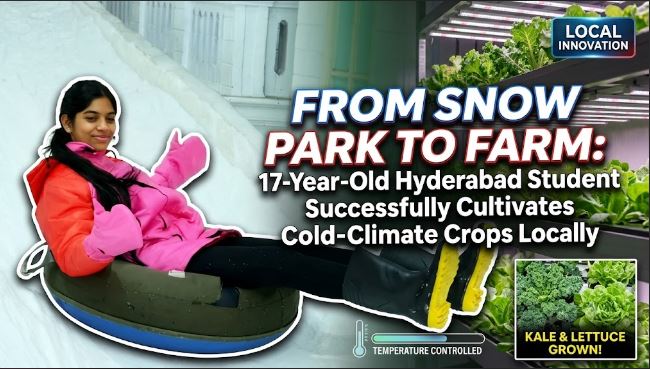
HYDERABAD — In a city where summer temperatures routinely breach the 40°C mark, high-value cold-climate produce like kale remains a costly luxury—imported across long distribution chains and sold at premium prices in gourmet markets. Now, a high school researcher is proving that controlled-environment agriculture could bring those exotic greens to local soil.
Shritha Shetty Puvvadi, a 17-year-old student at Oakridge International School, Gachibowli, has successfully demonstrated that cold-climate crops can thrive in Hyderabad using controlled temperature environments.
The project stems from Shritha’s broader study of Indian agricultural economics, particularly the financial vulnerabilities smallholders face due to unpredictable market prices, surging input costs, and razor-thin profit margins. Inspired by government initiatives like the Pradhan Mantri Mudra Yojana—which provides micro-financing to rural entrepreneurs—she set out to explore whether high-value cash crops could offer small-scale farmers a viable alternative income stream.
To test her hypothesis, Shritha repurposed a temperature-controlled chamber at her family’s Snow Kingdom facility in Hyderabad. Over the course of the experiment, she tested three distinct kale varieties:
Winterbor: Exhibited strong resilience and consistent growth output under managed cooling.
Red Russian: Successfully adapted to step-down temperature drops with healthy foliage.
Vates: Maintained solid leaf structure and steady development throughout the trial.
By incrementally lowering the ambient temperature, she pinpointed the ideal microclimate required for all three varieties to remain healthy, productive, and commercially viable.
While still an initial proof-of-concept, the success of the trial highlights the potential of controlled-environment agriculture to bridge the gap between technical innovation, sustainable farming, and lucrative market opportunities in Telangana.